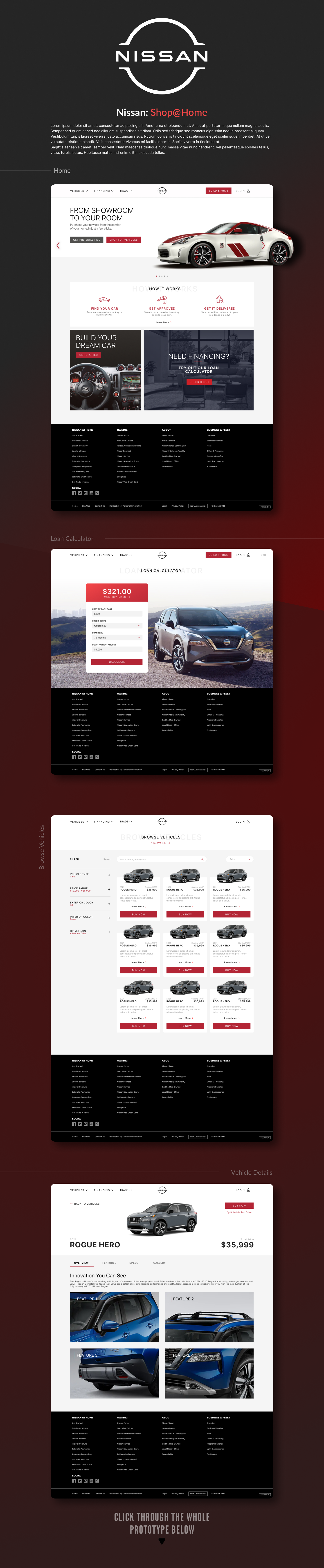
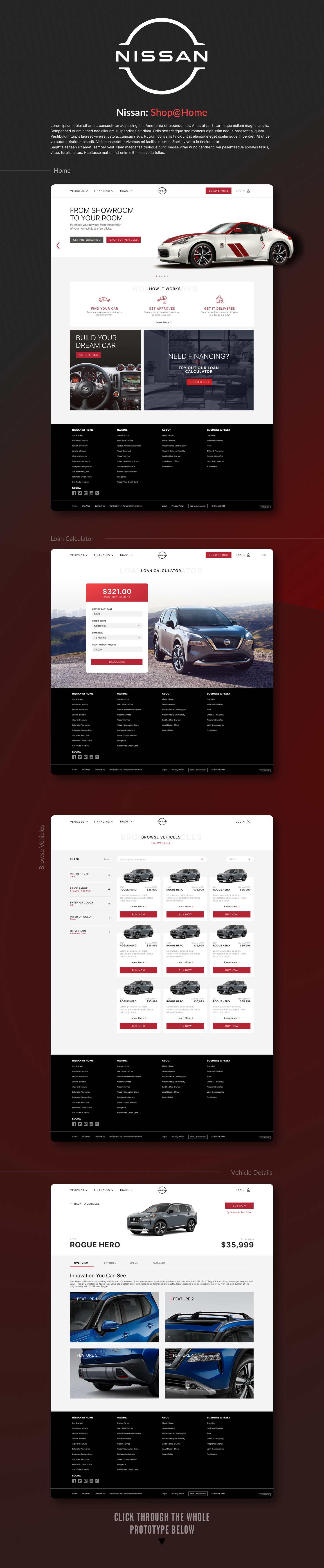
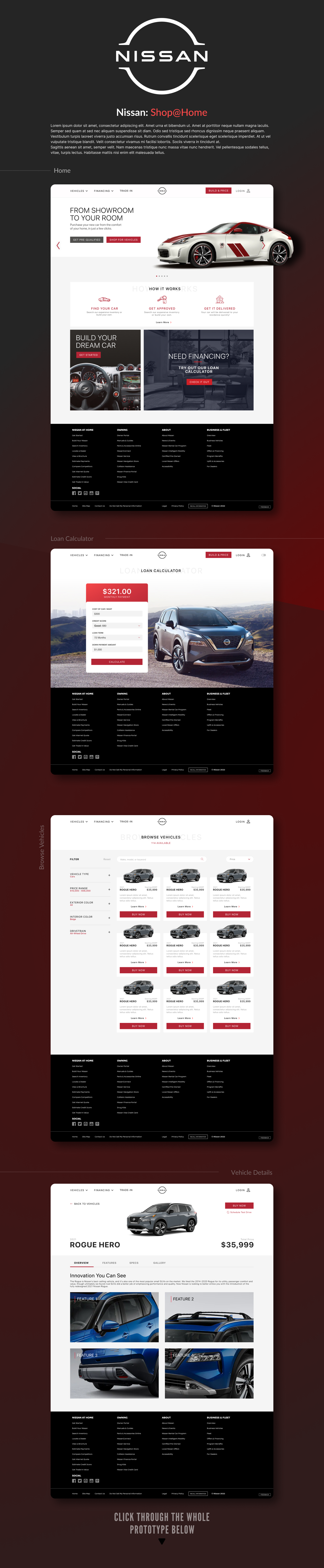
When Covid closed dealership doors overnight, Nissan needed a way to keep selling cars. We designed a Carvana-style shop-from-home experience — letting customers browse, configure, finance, and arrange home delivery entirely online.
01 — CHALLENGE
When Covid-19 hit in 2020, dealerships across the country were forced to close their doors — and Nissan's traditional sales model came to a hard stop overnight. Customers still needed cars. Nissan still needed to sell them. But the only path between buyer and vehicle was a showroom that no longer existed. Nissan North America needed a digital retail experience, fast — one that could replicate the full purchase journey online and get cars delivered directly to customers' driveways.
The brief was clear: build something like Carvana, but for new Nissans. Customers needed to be able to browse the full inventory, configure their vehicle, see real pricing and financing options, value a trade-in, and schedule home delivery — without ever setting foot in a dealership. The urgency of the moment removed any ambiguity about what had to be built. The question was how to build it in a way that felt trustworthy, transparent, and genuinely easier than the process it was replacing.
"I'm not going into a dealership right now. If I can't buy a car from my couch and have it show up in my driveway, I'm just going to wait."— Nissan Customer, Research Interview
PROJECT OVERVIEW
02 — RESEARCH
Covid accelerated a shift that had been building for years — consumers were already doing the majority of their car research online, but the actual purchase had remained stubbornly tied to the dealership floor. The pandemic didn't just remove that option; it showed buyers that they didn't want it back. We researched how people were navigating car buying during lockdowns, what they feared about going fully digital, and what the Carvana and Vroom models were getting right that traditional OEMs weren't.
28 recent car buyers
Interviews with buyers who had purchased or attempted to purchase during the pandemic — mapping what broke down, what they wished existed, and what would have given them the confidence to complete a purchase fully online.
Carvana, Vroom, Tesla + 3 OEMs
Deep dive into how digital-native auto retailers were handling the full purchase flow — identifying the transparency, delivery, and trust signals that made Carvana's model resonate with buyers who were skeptical of traditional dealerships.
18 target buyers
Tested three POC directions against buyer concerns — particularly around pricing opacity, delivery logistics, and what level of human contact (if any) they still wanted before committing to a vehicle purchase sight-unseen.
03 — PROCESS
The POC was designed to prove that Nissan could deliver a Carvana-quality buying experience for new vehicles — something no major OEM had successfully done at the time. We mapped the complete home-purchase journey: browse inventory, configure the vehicle, get a real financing estimate, value a trade-in, and schedule home delivery. Every step that previously required a salesperson, a finance office, or a lot visit had to be reimagined as a self-serve digital interaction that buyers could complete from their living room. The design philosophy centered on one principle: if Carvana can sell a used car this way, there's no reason a new Nissan should be harder.
CONCEPT EXPLORATION
DESIGN ITERATION
04 — SOLUTION
The experience followed a clear three-act flow built around how people actually decide to buy a car: Browse & Build, Price & Finance, and Deliver. In Browse & Build, customers could explore the full Nissan lineup, filter by model and trim, and configure their exact vehicle with live pricing that updated in real time — no "call for pricing," no hidden costs. The configurator was designed to give buyers the same confidence they'd get from seeing a car on a lot, with the added benefit of never having to negotiate.
Price & Finance brought full cost transparency to a process that's historically been opaque and adversarial — showing real monthly payment estimates, rate ranges, and a complete cost breakdown including taxes and fees before any commitment was made. Trade-in valuation was built directly into the flow so buyers could see the net price of their new vehicle with their existing car factored in. The final step, Deliver, let customers select a delivery window and a doorstep location — removing the last reason anyone needed to visit a dealership.
FINAL PRODUCT
Full inventory browsing with real-time vehicle configuration — customers could spec their exact Nissan with live pricing, just like building on a lot, but from their couch with no sales pressure and no hidden numbers.
Real monthly payment estimates, rate ranges, and an all-in cost breakdown — taxes, fees, and trade-in value included — shown before any commitment. The end of "contact dealer for pricing."
Customers could select a delivery window and confirm their address — completing the entire purchase without ever setting foot in a dealership. The car comes to them, not the other way around.
05 — RESULTS
The POC was presented to Nissan North America leadership at a moment when the urgency of the problem couldn't be overstated — dealerships were closed and sales had stalled. The prototype demonstrated a credible, end-to-end path to home delivery that stakeholders could see and interact with, and it received executive sign-off for a phased development program. User testing showed purchase confidence and intent scores that significantly outperformed the existing digital retail experience, with the home delivery scheduling and upfront pricing features generating the strongest response from buyers who had previously said they'd never buy a car without a test drive.
06 — LEARNINGS
Covid did in months what years of digital retail advocacy hadn't: it gave a major OEM the mandate to actually build something. The lesson wasn't just about car buying — external pressure can unlock design decisions that seemed impossible before the pressure existed. When the dealership option disappears, the digital option suddenly looks very good.
Home delivery wasn't just a logistical detail — it was the entire value proposition that made buyers willing to purchase without a test drive. Carvana figured this out early. For Nissan, designing the delivery scheduling step with the same care as the vehicle configurator was the difference between a digital brochure and a genuine commerce experience.
The single biggest design decision that moved buyer confidence was showing the real, all-in price — monthly payment, rate range, taxes, fees, trade-in — before asking for any commitment. Buyers had been conditioned to distrust automotive pricing. Removing that ambiguity didn't just reduce anxiety; it was the reason people said they'd actually complete the purchase online.